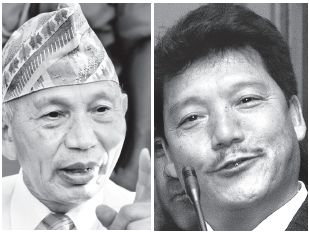
Mamata heads for Darjeeling to improve GJM ties

KOLKATA: Chief minister Mamata Banerjee is likely to visit the Hills on May 14 to hold talks with Gorkha Janmukti Morcha (GJM) leaders and sort out all issues regarding the Gorkhaland Territorial Administration (GTA). She also has plans to meet the members of the Lepcha Development Board (LDB) and find out the present state of its functioning. During Mamata's visit to the Hills in March, the GJM leaders had accused her of dictating terms to the GTA and some GJM supporters had even protested against her in a government programme . GJM had also criticized her for forming the development council for the Lepchas against their will. It might be mentioned that after coming to power a tripartite agreement in July 2011 was signed by representatives of the Centre, state government and GJM to bring peace. Right now when the tourism season is setting in, Mamata wants to show the GJM leaders that during peace time tourism can flourish. Officials said that in order to improve the relationship with GJM, she is planning her Hills trip at a time when GNLF is also gaining grounds in some parts of the Hills. 

A tripartite meeting is likely to take place on May 13 in Darjeeling, where the Centre, state and GJM will hold talks for smooth functioning of the GTA. Moreover, the three-tier panchayat which is yet to gain the constitutional status is going to be discussed at the meeting where state home secretary Basudeb Banerjee will also be present. Also, problems related to the functioning of fair-price shops in the subdivisional hospitals of Darjeeling will be discussed. Already there is a demand for a medical college in the hills and that too will be discussed. GJM leaders have also demanded a separate school service commission and college service commission for recruiting Hills people and a recruitment agency for hiring Group B, C and D staff. On Tuesday, GJM leaders led by secretary Roshan Giri met chief secretary Sanjay Mitra and home secretary Basudeb Banerjee at the Writers' Buildings to discuss the progress on the formation of Gorkhaland Territorial Administration (GTA). 

After the meeting, Giri said that they held talks on a host of issues, including the cases on some GJM leaders and funds for infrastructure development. "Several GJM workers are still carrying the cases that were charged on them during the agitation and that these cases have to be withdrawn. The chief minister will be informed in detail about the matter. Earlier one time fund of about Rs 575 crore was asked to the state government for developing the infrastructure but the fund is yet to be sanctioned. The matter will be discussed in the review committee meeting to be held soon. A total of 13 mouzas were transferred to GTA but the schools, colleges, primary health centers and many other offices falling in these mouzas are yet to be transferred to GTA. Also, 30 departments are yet to be transfered to GTA and the process should be expedited.

(Times Of India)

23:24 | Posted in , | Read More »

2 Gorkha Generals wins Gallantry Awards

The President distributes awards of 359 Gallantry and other Defence decorations to Armed Forces personnel and others. This includes 01 Kirti Chakra, 11 Shaurya Chakra, 56 Sena Medal (Gallantry), 01 Bar to Nao Sena Medal (Gallantry), 03 Nao Sena Medal (Gallantry), 03 Vayu Sena Medal (Gallantry), 28 Param Vishisht Seva Medal, 03 Uttam Yudh Seva Medal, 06 Bar to Ati Vishisht Seva Medal, 44 Ati Vishisht Seva Medal, 12 Yudh Seva Medal, 02 Bar to Sena Medal (Devotion to Duty), 37 Sena Medal (Devotion to Duty), 01 Bar to Nao Sena Medal (Devotion to Duty), 07 Nao Sena Medal (Devotion to Duty), 14 Vayu Sena Medal (Devotion to Duty), 04 Bar to Vishisht Seva Medal and 116 Vishisht Seva Medal. In addition a total of ten Mention-In-Despatches have also been announced for participating in Operation Rakshak and Operation Rhino.

Gorkha Recipients of Gallantry Awards

UTTAM YUDH SEVA MEDAL

- IC-31052X Liutinent General Shakti Gurung AVSM, VISHISHT SM INFANTRY / HEADQUARTERS 4TH CORPS

ATI VISHISHT SEVA MEDAL

- IC-35626W MAJOR GENERAL UMESH KUMAR GURUNG, YSM INFANTRY / HEADQUARTERS Inspector General Assam Rifles (SOUTH)

SENA MEDAL - GALLANTRY

- 13763846H LANCE NAIK AJAY KUMAR THAPA 3RD BATTALION THE JAMMU AND KASHMIR  RIFLES

03:32 | Posted in , , , | Read More »

Names of 5 Gorkha Soldier who killed in Road Accident near Jaisalmer

JAISALMER: 5 jawans of Gorkha regiment were killed and four others were injured when an Army truck overturned near Sonu village in Ramgarh area, 45 km from Jaisalmer on Thursday. All the jawans were residents of Nepal. The ammunition in the truck got scattered on the road but were shifted later. The injured were taken to Army hospital in Jodhpur by helicopter. The Army has ordered a court of inquiry. SP Pankaj Choudhary said that the Army vehicle was going to Ramgarh from Sonu and was carrying some ammunition. Just 2 km before Sonu, the vehicle lost control and overturned. 

Name of Soldiers 

Prem Kumar Limbu (25)
Prem Bahadur Rai (27)
Jeet Kumar Limbu (25)
Amrit Kumar (25)
Mohan Chhetri (25)

All residents of Nepal, died on the spot. 4 injured jawans were shifted to a hospital. Later they were sent to Jodhpur Army hospital by helicopter. Defence ministry spokesperson Col SD Goswami, confirming about the incident said that Army has ordered a court of inquiry.

00:33 | Posted in , , | Read More »

Puran Bahadur Thapa: India’s first Hat-Trick Man


In a small locality, Nong-Sohphh, Naspati-ghari in upper Mawprem, Shillong, an 86-year old man recovering from a heart operation is nostalgically recalling his experiences on the football field. This ailing patient is none other than the legendary Lt. Col. (Retd.) Puran Bahadur Thapa, whose delectable body swerves and thunderous left-footed shots entertained fans from Kashmir to Kanyakumari in the 1950s.  He had large and powerful thighs, a low centre of gravity, could turn quickly and unleash powerful but accurate shots from any angle. Throughout his career, he played as either an inside left or outside left. Despite several offers from Kolkata clubs, he never left the security of his army job. Born in 1928, he joined the Indian Army in 1947. After his football career was over, he excelled as a soldier and retired as Lt. Colonel. He played for the 8th Gorkha Rifles and Gorkha Brigade, represented Services in the Santosh trophy and played on several occasions for India.

This now forgotten man of Indian football became a household name 49 years ago, when he scored a hat-trick in an international match, at the Eden Gardens, Kolkata in the Quadrangular football tournament against Pakistan. It was the first hat-trick by an Indian in international football. Puran Bahadur’s hat-trick enabled India win the tie 3-1 and win the Quadrangular trophy for the third successive year. Overall, this tournament was held for four years, 1952-55) and Indian won each time, never losing a match to any of their opponents, Burma (now Myanmar), Pakistan and Ceylon (now Sri Lanka). In 1954, the only year this event was staged in India, the great S.A. Rahim was India’s coach and the late Sailen Manna was India’s captain. Puran Bahadur was the star of that tournament. In the opening match against tenacious Ceylon, he created the only goal with a measured cross for overlapping left-half Noor Mohammed. In the next match, he and J. Anthony scored in the 2-1 win over Burma. Then came the icing on the cake, as his hat-trick against Pakistan helped India win the tournament. In those days, Pakistan was quite a formidable team and included the skilful outside left Masud Fakhri, who later played 2nd division league football in England.

In 1955, he again excelled for India when they won the Quadrangular tournament for the fourth time, beating Ceylon 4-3, Burma 5-2 and Pakistan 2-1. The tournament was staged in Dhaka and S.K. Azizuddin was India’s captain. That same year, Puran Bahadur lined up for India against the USSR Services team in an international match at the National Stadium, in Delhi. This USSR Services team contained legendary names like goalkeeper Lev Yashin, midfielders Igor Netto and Boris Tatushin. This trio and some others in that team were members of the USSR team, which a year later won the gold medal in the 1956 Melbourne Olympics. Yet, on that sunny winter’s day in Delhi, they struggled to contain the mesmeric dribbling skills of Puran Bahadur. Oozing with confidence, he repeatedly evaded his marker with body swerves and sharp dribbles. The Soviet players were amazed at his ball skills, game sense and fitness. After the match, the manager of the Soviet team went to the press box and asked some of the local media about the background of Puran Bahadur. His left-footed shots were so accurate and powerful that famous Indian goalkeeper Peter Thangaraj always said that he would always be left stranded whenever Puran Bahadur took a penalty kick against him in practice or in matches.

Yet, for all his skills and popularity, Puran Bahadur did not play for India in any major international tournament like the Asian Games or the Olympics. He represented India in two Quadrangular tournaments on foreign tours to Afghanistan in 1949, the Far East tour in 1951 and in friendly internationals on home soil. Injuries or work commitment deprived him of higher glories. However, this stockily built 5’4″ forward has no grudges and regrets about missing some famous tournaments, as the Army was his career. A certainty for the 1952 Helsinki Olympics, he was not given permission to attend the trials as he was commissioned as an officer in the Indian Army that year, and joined the Indian Military Academy in Dehra Dun. He was really unlucky not to be chosen for the 1954 Asian Games in Manila. Ahmed Khan, Puran Bahadur and J. Kittu were automatic choices on the left flank. But he got injured, compelling chief coach Balai Das Chatterjee to choose M. Jayaram (Services) in his place.

Again, knee trouble forced him to opt out from the 1956 Melbourne Olympics. Precocious teenagers Tulsidas Balaram and Zulfikar got selected on the left flank along with J. Kittu. During that period there was a lot of depth in Indian football, and competition was intense for each position, with three or four well-known names vying for one position. Also, Puran Bahadur remained with the Services and Gorkha Brigade, which did not have much of a say in the selection of the national team. It was felt that if he had played for a Bengal club, he would have played more for India. A combination of all these factors resulted in India’s first hat-trick man not getting his due recognition with regard to international appearances. But Puran Bahadur will always be remembered as a supreme entertainer. The Ambedkar Stadium in Delhi (known as the Delhi Gate Stadium in the 1950s) was his happy hunting ground, and he was always a crowd favourite. A charismatic player, he had numerous fans from all communities and walks of life in the capital. In the now defunct DCM football tournament he guided the 8th Gorkhas, Dehradun to three consecutive finals, from 1950—52. In 1950, they lost to East Bengal 2-2, 0-2 and in 1951 to Rajasthan Club, Calcutta 0-1 and again in 1952 to the all-conquering East Bengal 0-4 in the final. In 1952, East Bengal also beat Hyderabad City Police 1-0 in the Durand final and became the first team to win the “Delhi double” the DCM and Durand tournament in the same year.

His finest hour was in the 1953 Durand tournament when he played for the National Defence Academy and the team, consisting mostly of young cadets, unexpectedly reached the final. In the quarterfinals they upset mighty East Bengal 2-0.  East Bengal had renowned international forwards in outside right P. Venkatesh, inside left J. Kittu and outside left Ahmed Khan. However, they were all eclipsed by the all-round skills of Puran Bahadur. In the semifinals, they played Mohammedan Sporting thrice before beating their renowned opponents. There were no penalty shootouts in those days and replays were common place. In the final, they were exhausted after playing so many matches within a week, and lost 0-4 to Mohun Bagan, for whom internationals S. Raman(1948 London Olympics) and Samar “Badru” Banerjee, India’s captain in the 1956 Melbourne Olympics, each scored a brace. During the 1953 Durand tournament, Puran Bahadur forged a telepathic combination with centre forward Moloy “Mike” Lahiri, which continued till they both retired from the game in 1960. Both also excelled in the 1958 Durand tournament. Inside left Puran Bahadur, with his crisp through passes and accurate crosses, created havoc. Gorkha Brigade upset the 1957 Durand champions Hyderabad City Police 3-1 in the quarterfinals and later in the semifinals ousted Indian Air Force 3-0. In the first all-regimental Durand final since Independence, Madras Regimental Centre (MRC) Wellington beat Gorkha Brigade 2-0 in the final.

A prolific goal-scorer, Lahiri scored many goals from Puran Bahadur’s probing passes. They belonged to an age gone by in their reactions during the game. After scoring a goal, Lahiri would raise his arm towards Puran Bahadur and acknowledge the pass with a smile. There was no excessive emotion and celebrations, or scenes of hugging and smothering the goalscorer and gesticulating towards the crowds. Both Lahiri and Puran Bahadur never thought of leaving the Indian Army and playing club football in Calcutta or Bombay. Both played for India but not as much as they should have. Lahiri was controversially dropped from the squad announced for the 1960 Rome Olympics and named as the first reserve though he was a regular in the national team since 1958. The non-selection devastated him and he quit the game months later, devoting himself to his Army career. Lahiri had a distinguished career as he went on to Fort Bragg, North Carolina to become India’s first Green Beret Ranger and then raised the Commando wing of the Infantry school, Mhow. He retired as a much-acclaimed Lt. General but sadly died of cancer some years ago. Puran Bahadur, now in the twilight of his life, is still a keen follower of Indian football, and laments that there is not as much depth in talent as was present in his playing days. He has two sons Ajay and Vijay Thapa. Ajay Thapa was captain of the St. Anthony’s Shillong school team which won the 1978 Subroto Mukherjee Cup beating Madhyamgram HS, Bengal 1-0 in the final, but then started his own business.

By : Novy Kapadia

Source - sportskeeda.com

00:04 | Posted in , , , , | Read More »

राजस्थान में 5 गोरखा जवानों की सडक दुर्घटना में मौत

जोधपुर : राजस्थान के जैसलमेर में गोरखा रेजिमेंट के पांच जवानों की सड़क दुर्घटना में मौत हो गयी. राजस्थान के जैसलमेर जिले के रामगढ थाना इलाके के सानू गांव के निकट गुरुवार को सेना का एक ट्रक पलटने से गोरखा रेजिमेंट के पांच जवानों की मौत हो गई और चार अन्य घायल हो गये. पुलिस सूत्रों के अनुसार रामगढ की ओर आ रहा सेना का ट्रक अनियंत्रित होकर पलट गया, जिससे पांच जवानों की मौत हो गई. घायलों को सेना के हेलीकाप्टर से जोधपुर के सेना के अस्पताल लाया गया है. मारे गये पाचों जवान नेपाल के रहने वाले थे.  उन्होंने बताया कि मृतकों के नाम का फिलहाल खुलासा नहीं किया गया है. मृतक जवानों के शव सेना के अधिकारी मौके से लेकर रवाना हो गये. जिले के वरिष्ठ प्रशासनिक एवं पुलिस अधिकारी मौके के लिए रवाना हो गये है. इधर, सेना प्रवक्ता के अनुसार हादसे के कारणों की जांच के लिए ‘कोर्ट आफ इन्कवारी’ के आदेश दे दिये गये है.

05:00 | Posted in , | Read More »

Chris Gayle slams 30-Ball Ton, fastest in History

Benguluru: Explosive opener Chris Gayle slammed the fastest century in cricket history, reaching the triple figure in just 30 balls during the RCB-PWI IPL clash on Today. Though, the milestone came in an IPL clash, and not in any international tie, Gayle's firework will be remembered by cricket buffs for long. The southpaw pulverised the Pune bowling and hit 16 sixes and 11 Fours, during the process, to send the crowd in delirium. This was Gayle's second ton in his IPL career. Pakistan's flamboyant batsman Shahid Afridi holds the record of fastest century in ODI (37 balls) while, Viv Richards is credited for scoring fastest ton (56 balls) in Test history. South African Richard RE Levi holds the record for fastest international T20 hundred. Levi had slammed 45-ball century against New Zealand in 2011 at Hamilton.

05:27 | Posted in , | Read More »

Pabin Rai : The First Gurkha Girl in British Army

When Pabin Rai called her parents in Dharan with the news that she had been drafted into the British Army, her parents refused to believe her. Her sister even gave her a bit of a telling-off for lying. "I had to cross my heart and promise I wasn't making it up," she says. "They only believed me when I sent them the certificate saying I had joined." Now a Lance Corporal in the First Battalion Grenadier Guards, Pabin Rai had sent her application to join the army in 2004 without the knowledge of her family; at the time, she was the only Nepali girl to have applied. When they found that she had been recruited into the 2 PARA Regiment of the British Army, her father felt proud and sent her his congratulations. Disbelief is the common reaction she receives. When friends and neighbour hear her say, "I am in the British Armed Forces" they automatically assume she is an army spouse. This is because women are not allowed in the British Gurkha Regiment – for which selection is done here in Nepal. 

The UK's Ministry of Defence had at one point floated a proposal to recruit female soldiers, but later abandoned the idea saying it was impractical. So Pabin, daughter of an ex-British Gurkha soldier, used her British Overseas National Passport privileges to sign up to the British Armed Forces, which recruits British nationals. "When I saw my father in the army uniform, I wanted to be like him," she says. But when she found out she wouldn't be able to sign up as a Gurkha like he did, she thought she would be a police superintendent instead. "I thought it would be cool." "I just thought I wasn't any different than the boys," Pabin says. Growing up in Dharan, she was known in her school as the kick-ass karate and football player. Her energy and determination to set herself apart from her peers led her to the army. When in the UK to pursue further studies, she found out that she could apply to the army like anyone else. Of course, she didn't hesitate. The first pang of regret came when she broke her left leg during the initial army training. The injury made her bed-ridden for a month and she felt foolish for having made the decision to join. However, before long she began to see it as a challenge and became even more determined to do well.

In fact, the training proved to be only a gentle preview for the experiences that lay ahead when she was posted to Afghanistan. As part of the unit that is widely regarded as the toughest unit in the British armed forces, because of its strict selection criteria and rigorous training process, she conducted two tours of duty in the country in 2008 and 2010. During her first tour of duty, she lost three friends on the frontline. At one point, she had been manning a sentry when a bomb exploded just 200 metres away from her. On her second tour of duty, she lost two more friends when they were attacked by the Taliban in the operating base of Keenan. "You never know what will happen in the life of a soldier," she said recently while on holiday in Hong Kong. 

Despite the risks, a career in the British army is a coveted one, as is evident by the number of queries she receives from Nepali girls wanting to join. A few more young Nepali females have been recruited since Pabin: Chitra Shrestha (Gurung) and Rajani Gurung are two of them. "I think we are trying to prove that we are as capable as the men," she says. "I am proud to be working alongside men here." Though they train and work together, the female soldiers have separate residential quarters. In fact, in many ways the women have more benefits than the male Gurkha soldiers she had envied so much. At £2,500 salary per month, she earns more than Gurkha soldiers, a matter that has become the subject of court battles and political hearings. 

Pabin's parents, Indra Bahadur and Pramila, had never imagined that their daughter would join the army. They had wanted their son Diwash to follow in his father's footsteps, and to please his father, he tried twice to enlist in the Gurkha battalion, but was unsuccessful. His sister's recruitment when she was in the UK surprised everyone. Pramila had never heard of female soldiers and found it hard to believe that her daughter was now one of them. "She's had this habit of being playful and joking around since she was a child, so I didn't imagine she was being serious," she tells us. At which point Pabin jumps in: "If your son had made it this far, you probably would have been delirious with joy. But you refused to believe me." After the eventual euphoria, parental instincts took over. In his 16-year-long career in the army, Indra Bahadur was never called to the frontline. He was on stand-by reserve during the Falklands war, but was spared from frontline war experience. 

He went to Afghanistan for a visit, but not during the war. When they found out that Pabin was going to be sent to Afghanistan, Indra Bahadur and Pramila became sick with worry. Her mother, who had never paid much attention to the news, suddenly found herself transfixed to the television. "There was news of Afghanistan all the time, bombs going off, and attacks. My eyes were glued on the screen all the time, and my heart was heavy with concern for my daughter," she shares. Since joining the army, Pabin has been back to visit her parents only a couple of times. During Dashain and other festivals, her parents wish she was in Dharan with them. As with all their children, Indra Bahadur and Pramila hope Pabin will spend life after retirement in Nepal. It so happens that there are no differences of opinion on this. "I am a Nepali no matter where I am and what I do," says Pabin. "I will definitely come back to Nepal." 

(Source - www.wavemag.com.np/issue/article3608.html )

23:16 | Posted in , , , | Read More »

Ghising's GNLF sets out to renew Units in Darjeeling

DARJEELING: The Gorkha National Liberation Front (GNLF) plans to re-establish its branch committees, which were dissolved around four years ago in the three Hills sub-divisions. Recently, GNLF chief Subash Ghisingh, in exile in Jalpaiguri, had announced appointment of chief conveners M G Subba, Nima Lama and Maurice Kalikotey for Darjeeling, Kurseong and Kalimpong, respectively. "Within a month, we will form our branch committees in the sub-divisions as per the directive of our party president," Subba said on Thursday. According to the GNLF Darjeeling convener, Ghisingh has plans to revamp the functioning of party activity in the Hills. "The old politics of going against the own people must be shunned. Time has come for all stakeholders to work together," said Subba. The party will also launch an awareness campaign to garner support for including the Darjeeling Hills under the Sixth Schedule. "To develop the socio-economic fabric of the Hills, it is imperative that peace and stability is maintained. Fighting against each other will only provide opportunity to vested elements to take advantage," said Subba.

Subhash Ghisingh is "spent force": Gurung

Bimal Gurung called Subash Ghisingh a “spent force” in the hills, hours after the ousted hill leader’s party GNLF said it would be revive its branch committees soon. It is not known whether Gurung, who heads the autonomous GTA Sabha, had knowledge of the GNLF’s decision to revive its branch committees, which were once powerful bodies in the hills, but sources in the Gorkha Janmukti Morcha said the party was watching the GNLF keenly. At a gathering of the Morcha-affiliated Janmukti Asthai Karmachari Sangathan at the Gorkha Rangamanch Bhavan, Gurung said: “I get to hear that some people are trying to organise themselves in various parts of the hills but there is nothing to worry about.” 

He said: “Ghisingh is a spent force and even his age is against him. Even during the 1986 agitation, 40 per cent of the hill population was with the CPM.... Even then the CPM could do nothing and at this moment, the GNLF too can do nothing in the hills.” In the last few weeks, around 200 Morcha supporters have moved to the GNLF, which has been inactive in the hills since 2008. The numbers may not worry the Morcha but the GNLF’s effort to regroup is a cause of some concern. A senior Morcha leader, on condition of anonymity, said: “Our party president’s speech is a clear indication that the re-emergence of the GNLF is not a comfortable situation. The party has to be on the vigil even though we don’t see the GNLF as an immediate threat.” That the GNLF managed to muster around 5,000 supporters in Simulbari for its foundation day on April 5 would not be lost on the Morcha. Gurung today said Ghisingh practised the “politics of lies”.“We are in the hills now (as a political force). Even though no political person can claim to last forever, we are not like Ghisingh who would only believe in the politics of lies. He dropped the demand for Gorkhaland but continued to say ‘we want Gorkhaland’. The Morcha, has not dropped the statehood demand,” he said. “You (GNLF supporters) could be practical and move with the times.” 

Hours before Gurung spoke, M.G. Subba, recently appointed the Darjeeling convener of the GNLF, said the party is ready to revive its branch committees in Darjeeling, Kalimpong and Kurseong within a fortnight. “Many of our supporters are coming out in the open. We have decided to revive the party’s branch committees in Darjeeling, Kalimpong and Kurseong within a fortnight,” he said here. At the Gorkha Rangamanch Bhavan, Gurung today lamented the lack of work culture among GTA employees but also promised to regularise jobs of the 6,000-odd GTA employees. “If you need work, I too will demand work from you. In these eight months (of running the GTA), I have realised that the work culture is extremely poor...,” he said. “We will soon form a subordinate selection board and we will regularise your jobs.” But administrative sources said that regularising a 6,000-strong work force would not be easy as financial sanction for salaries would have to come from the state.

( Telegraph)

00:02 | Posted in , , , , | Read More »

20 year old Nepali girl abducted, gang-raped

New Delhi: In yet another shocker from national capital, a Nepali girl in her early 20s was allegedly gang-raped in Delhi, police said on Thursday. The girl was found in half-naked and semi-conscious condition near Nanakpura flyover in south Delhi around 7.30 am on Thursday. The victim was taken to Safdarjung Hospital where she is being treated. According to her statement to police, she was abducted from Kotla Mubarkpur area near South Extension in south Delhi on Wednesday night by three unidentified people, who raped and dumped her near the flyover. 

23:50 | Posted in , | Read More »

Gorkha Lt. General G.S. Rawat , PVSM, AVSM

Lieutenant General Gajendra Singh Rawat, PVSM, AVSM was born in a village of Deoltha, Pithoragarh Dist. Kumaon hills on 17th December 1926. He is the first General Officer from the Kumaon Dist. He comes from a family which has rendered conspicuous service to the army for over 130 years. Hid great grand father and grand father served in the 3rd Gorkhas as junior Commissioned Officers and his father Brigadier N.S. Rawat retired after 32 years of meretious service. His younger brother, Commander M.S. Rawat (Indian Navy), was the winner of the President's gold medal from the joint services wing in 1952. His younger brother also served as captain in the Garhwal Rifles in the 1965 war with Pakistan: He has been educated at the Sherwood College and St. Joseph's College at Nainital and finally when doing his B.Sc from the Allahabad University, he got selected for a Direct Commission in the Indian Army in 1946. He was commissioned on 21st December 1947 from the second post-war regular course, into the Gorkha Rifles (Frontier Force) and was amongst the first lit of officers to be posted into the Gorkhas. He took part in the J&K operations in 1948 with the Battalion in the Zojila operations and in the capture of Kargil. He attended the Defence Service staff College course - Wellington in 1957-58. He was an instructor at the Infantry School Mhow form 1959-62. He raised and commended a Scouts Battalion in the Up Tibet Border (Mountainous region) from April 1964 to October 1966. From 1966-69, he was an instructor at the Defence Services Staff College from April 1969 to May 1971 he commanded an Infantry Brigade in the plains sector. 

He was the Brigadier General (Staff) in Headquarters Corps (having formations deployed in mountainous and high altitude regions) from 1971 to 1972 from where he was posted again as Brigadier General Staff to the newly raised Corps. Headquarters. Then he took over as a General officer Commanding, an Infantry Division from January 1974 to July 1974 and was rushed to a Mountain Division in Nagaland and Manipur (Jungle/ Mountainous area) where the previous General Officer Commanding was wounded and had to be evacuated. It was during his tenure that peace was ushered in those areas, thus bringing to an end two decades of strife. From that assignment he was posted as commandant, Indian Military Academy - Dehra Dun in October 1976. He was the first Commandant of the Indian Military Academy who was commissioned from the first post war batch commissioned in Independent India in 1947. He was the General Officer Commanding Delhi area from February 1979 to June 1979. On promotion as Lieutenant General he was appointed as the Military Secretary at Army Headquarters. In September 1981, he took over a Corps in the northern sector of Jammu and Kashmir. In recognition of his services during the 1972 war, he was awarded the Ati Vishisht Seva Medal in 1972 and for his services in Nagaland and Manipur the Param Vishisht Seva Medal in 1976. He took over as Colonel of the Jammu and Kashmir Rifles and Ladakh Scouts in December 1974. He retired as the Vice Chief of Army Staff on the 31st December 1984. He married in 1955 and has three children, two sons and a daughter.

23:45 | Posted in , , , | Read More »

Brigadier Sher Jung Thapa : The Hero of Skardu

Since Independence, India has witnessed three wars with Pakistan in Kashmir. The stories of gallant deeds and valour of our soldiers continue to haunt our minds. One such heroic tale is of late Brigadier Sher Jung Thapa, MVC. But for his siege of Skardu in the Ladakh region of Kashmir for over six months, Ladakh might have been wiped out from the Indian map. Brigadier Sher Jung Thapa died in Dharamsala a couple of 14 Years ago at the age of 90 yearsin 1999. He is remembered and revered as the Hero of Skardu. Though he is no more, his heroic deeds are today part of the glorious history of the Indian Army. Sher Jung Thapa was born in Abbottabad on 18 June 1908. His grandfather and father were distinguished soldiers. Thapa had his college education at Dharamsala. He was an excellent hockey player and frequently played with stalwarts of 1 Gorkha Rifles, Regimental Centre, Dharamsala. In the hockey field, he became a close friend of Captain Douglas Gracy, Adjutant of 1 GR RC, who encouraged Thapa to join the forces of Jammu & Kashmir state as an officer. Thapa took his advice and was commissioned on 01 September 1932. Thapa met Gracy again after a lapse of 25 years under different circumstances.

Lieutenant Colonel Thapa was a Prisoner of War (PoW) in Pakistan and General Sir Douglas Gracy was the Commander-in-Chief of the Pakistan Army. Lieutenant Colonel Thapa's friendship with General Gracy came to his rescue otherwise he would have met the fate of other prisoners of war who were killed by the Pakistani Army. A small and narrow valley at a height of 7500 feet above sea level, Skardu is divided into two parts by the Indus river. Before the arrival of Lieutenant Colonel Sher Jung Thapa at Skardu, the Wazir Amar Nath Mahajan saw the signs of a gathering storm. Skardu tehsil had a greater area under it than a normal tehsil. There were five jagirdars called Rajas, who exercised considerable influence over the population in their respective areas. They were Raja of Rondu; Raja of Khapalu; Raja of Shigar; Raja of Skardu and Raja of Kharmang. On 11 February 1948, Skardu was surrounded by an enemy of about 600 troops, while the strength of soldiers under Lieutenant Colonel Thapa of 6 JAK Rifles was only 130. He had to face many odds during the war against the Pakistani forces as scores of Muslims in the Skardu area had secretly joined the enemy. Not only this, many of the Muslim soldiers in Indian platoons deserted the army and joined the enemy. So much so that three Muslim wireless operators operating from the Bungalow of Lieutenant Colonel Thapa also deserted, thus jeopardising the signals. 

Once having worked as Brigade Signal Officer, Lieutenant Colonel Thapa himself operated the wireless set. Lieutenant Colonel M.L. Chhiber (Retd.) in his book Pakistan's Criminal Folly in Kashmir has quoted Brigadier Thapa on the indifferent attitude of Muslim community in Skardu area towards Indian troops. He said, "Every Muslim civil officer, schoolboys, servants of local shopkeepers and all who were employed to secure information about the enemy did not do so. They knew that the enemy was coming. They took all precautions to see that we were kept in the dark and then were attacked by surprise. This attitude of the Muslims there goes to prove how determined, united and eager they were. They wanted the Pakistan flag to fly. The Pakistan agents here did a thorough job." Gradually, the ration position started worsening. The Dogra soldiers who were addicted to smoking, used tree leaves and rice husk for smoking. They even went to the extent of rolling up tea leaves in mulberry leaves to make cigarettes.

Recounting those days later, Sher Jung Thapa said: "I vividly remembered 17 June 1948. We saw Sepoy Amarnath of 5 Kashmir Infantry being captured by the enemy at Parkutta. He was sent by the enemy to persuade us to surrender. The man was tutored to demoralise our men. He carried a letter from Colonel Shahazada-Mata-Ul-Malek, commanding the enemy forces. The offer was outrightly rejected by me." The night falling between 13 and 14 August 1948, saw a fierce battle at Skardu between Pakistani and Indian troops. Thapa said, "We used our last box of ammunition. Everyone knew our plight and there was panic and chaos all over. The women started committing suicide by jumping into the Indus and poisoning themselves in order to save their honour. There was an instance where a girl jumped thrice into the Indus to kill herself but each time the waves carried her back to the shore. My troops fought under very adverse conditions and held Skardu for six months and three days. Then was left with no alternative but to surrender. The surrender was followed by mass murder. All the Sikhs were shot dead. Captain Ganga Singh, my Adjutant was tied, laid on the ground and shot. The only Sikh who escaped was Kalyan Singh, my orderly who was staying with me."

In 1949, Prime Minister Jawaharlal Nehru visited Srinagar soon after the ceasefire to see the troops in the frontline. General Thimayya, Commander of 19 Infantry Division, also addressed the officers. In his address, General Thimayya said: "My strategy to save Ladakh was to hold on to Skardu at all costs so that Pakistani forces may be prevented from reaching Kargil and Leh. Fortunately, I had the right man in Skardu to fulfil this mission. No words can describe the gallantry and leadership of Lieutenant Colonel Sher Jung Thapa who held on to Skardu with hardly 250 men for six long months. It is one of the longest sieges in the annals of war. While ordering him to defend Skardu to the last man and last round, I had promised to send him reinforcements and supplies. Unfortunately neither could reach Skardu. I also tried to air drop more rations and ammunition but these were merely helping the enemy. At the end of six months, when he completely ran out of ration and ammunition, I asked him to surrender. My General Staff Officer, Colonel Shri Ram Oberoi, gave this order to the gallant officer on radio in August 1948. 

Thapa's response is etched on my mind and I can never forget it. He said, 'I know that I cannot hold out without rations and ammunitions. General Thimayya has failed me. I know the fate my troops will meet after surrendering to the enemy. I cannot do anything now against the enemy but I will certainly take revenge in my next life.' It is officers of this stamp who make great armies and great nations." Lieutenant Colonel Thapa was conferred with Maha Vir Chakra and he retired as a Brigadier in 1960. The extracts from the citation for MVC are worth quoting, "Throughout the period of siege, Lieutenant Colonel Sher Jung Thapa showed outstanding leadership and great determination in holding out...in spite of the enemy offering him liberal surrender terms and knowing that there was no hope of ever being relieved. By his personal example and indomitable spirit he kept the morale of both his troops and civilian refugees at a high level...his conduct has been in the best traditions of the Indian Army."

(The Tribune - 30 October 1999)

22:55 | Posted in , , , | Read More »

Exclusive 29 Pictures of Boston Marathon Blast

Boy aged EIGHT and 'woman in her twenties' among three dead in Boston Marathon bombings that have left another 144 injured with 17 critical: FBI and bomb squad surround apartment after following erratic driver as he sped past state police barracks. Boston Police Crime Scene Response unit arrived and two members of that unit took several brown paper bags, normally used to store evidence taken from the scene, into the building and left with them full afterwards. 

 Exclusive Pictures of Boston Marathon Bomb Blast


(Reuters and Daily Mai)

23:09 | Posted in , | Read More »